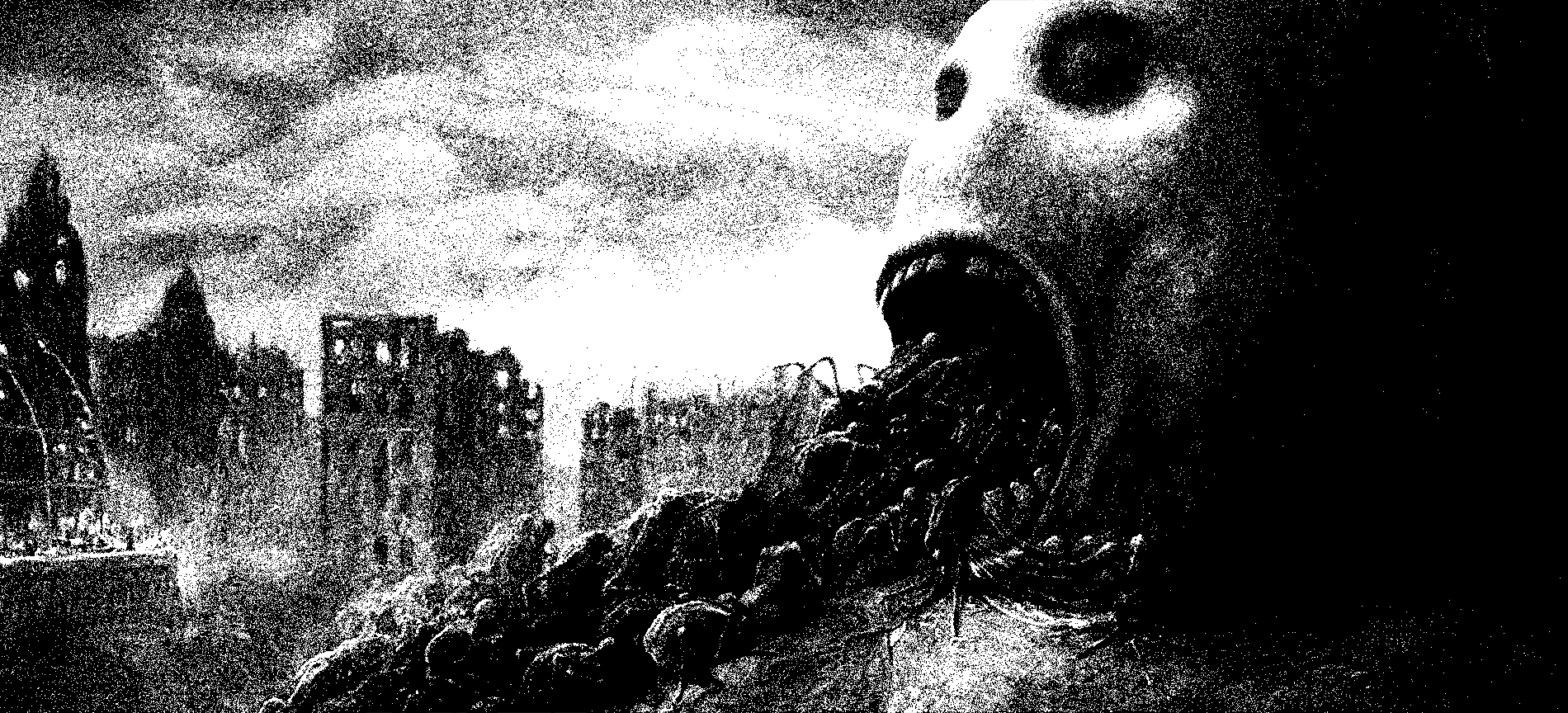
El capital no puede ni sabe detenerse. Está engranado en sus entrañas, en las mismas que trituran pueblos y memorias enteras. El capital es inescapable porque vivimos dentro de su membrana, dentro de una frontera que es invisible porque no conocemos lo que hay fuera. Es el modo de vida, el modo de producción, el modo de muerte, el modo de extinción. No sabemos otra cosa, pero conjeturamos perpetuamente. Tal vez hemos llegado a ese temido punto de inflexión final en el que nuestra especie se enfrenta al colapso, pero al más desgarrador de todos: disolverse en ácido, lentamente, incapaces de alzar la voz y levantar las manos.
El horror de los hornos y de los zapatos, el horror de todos esos gritos que tal vez solamente algunos animales no humanos escucharon, el horror de todo el gran mecanismo que se pone en marcha para alimentar a lo insaciable, está una vez más ante nuestros ojos. ¿Cuántas veces más deberá ser así? ¿Sabemos, de hecho, cuántas veces lo ha sido sin que nos demos cuenta —en absoluto— de la sangre que, bajo nuestros pies, se seca? No, no sabemos nada. Sabemos lo poco que no puede sistemáticamente borrarse o disolverse entre discursos, entre obras a medias, entre dádivas insignificantes. Sedativos para un pueblo planetario que tiene como verdugo a sus propios congéneres que, “enceguecidos”, cortan nuestras propias lenguas.
Pero no son ellos, no solamente ellos, quienes nos llevan al precipicio. Es el gran aparato tumoral que nos absorbe y que los copa, y con el que se co-construye. Son ellos, pero no son ellos. Es el tumor, pero no es solamente él. Es una asquerosa e insacra amalgama de idolatrías y de una proto-consciencia que, poco a poco, nace de entre las vísceras arrancadas de tantas víctimas y que se aferra a una vida de extracción, consumo, destrucción. Es el infierno que se configura frente a nuestros ojos, el eterno Tártaro de la creación de lo que es innecesario y de la deleción de lo que se aferraba a una tierra que hoy es envenenada. Es, pues, la antítesis de nuestro planeta. Si el planeta está vivo, entonces lo que vemos crecer en él es una enfermedad terrible y, tal vez, terminal.
En ese espacio de imposibilidades, no obstante, sabremos cosas. Sabremos del amor y sabremos de la camaradería. Sabremos sobre la compañía y sobre la soledad. Sabremos construir hilos, endebles y casi invisibles, de comunidad y de solidaridad. Nos sabremos inmensamente pequeños, y nos sabremos pugnantes. Creceremos, poco a poco, como un anticuerpo que se infla para intentar fagocitar los muy grandes pedazos del enorme tumor. Un tumor que está realizado materialmente entre fábricas y minas a cielo abierto. Y estudiaremos al invasor al que fuimos asimilados sin saber que lo estudiamos.
Entenderemos que, como todo lo que crece sin medida, no tiene un verdadero fin: actúa sin saber lo que hace, sin significado alguno. Actúa con reglas vacías y sobre elementos que nada le representan. Su finalidad es, pues, aplicar su lógica a todo hasta que no haya nada más a lo cual aplicarle sus discursos. Su finalidad no es, pues, la de persistir precariamente, sino la de persistir hasta que no haya más fricciones a las cuales enfrentarse.
En este momento es que postulo por primera vez que no veo en este enemigo un ser vivo al cual asesinar, sino lo que ahora creo que es un híbrido entre el organismo (con sus capacidades de autoconstruirse) y el espíritu nihilista de la máquina (con sus reglas y símbolos sin semántica). Es la peor consecuencia posible porque es una máquina oracular, una máquina que puede hacer lo que todas las demás máquinas no pueden. Es una hipermáquina, y nosotros somos sus entradas. Sus salidas son todos los destinos terribles, y los vivimos. Esa máquina, que poco a poco se crece, tiene un límite, y es a ese límite al que entiendo como membrana.
En esta pared mínimamente viable es donde nace también la esperanza de la demencia, de la locura, de hacer que todas las cosas que ocurren dentro salgan mal. De desmontar por completo el gran aparato catalítico del dolor. Porque, ¿qué es una máquina sin su lógica sino una colección de estados posibles que nunca se alcanzan?
De esto he de hablar más adelante, pero por lo pronto lo digo claro: pienso que hay salida, y la salida es la absoluta esquizofrenia instalada en las reglas del mecanismo. No tengo una receta, pero la buscaré. Y si no la encuentro yo, habrá quien lo haga.
A ti, devorador de mundos, escupiré mi último aliento.
— extremeEnd
Capital can neither stop nor does it know how to stop. It’s embedded in its very core—the same core that crushes entire peoples and memories. Capital is inescapable because we live inside its membrane, within a border that is invisible simply because we don’t know what lies beyond. It is our way of life, our mode of production, our mode of death, our mode of extinction. We know nothing else, but we perpetually speculate. Perhaps we have reached that dreaded final tipping point where our species confronts collapse—yet the most harrowing kind of all: dissolving in acid, slowly, unable to raise our voices or lift our hands.
The horror of the ovens and the shoes, the horror of all those screams that perhaps only some non-human animals heard, the horror of the entire great mechanism set in motion to feed the insatiable—is once again before our eyes. How many more times must it be so? Do we even know how many times it has happened without our slightest awareness—without any realization at all—of the blood drying beneath our feet? No, we know nothing. We only know what cannot systematically be erased or dissolved amidst discourses, unfinished works, and insignificant handouts. Sedatives for a planetary people whose executioners are their own kind who, “blinded,” cut out our tongues.
But it is not them—not only them—who lead us to the edge. It is the great tumoral apparatus that absorbs us and consumes them as well, and with which they are co-constructed. It is them, but it is not only them. It is the tumor, but not solely it. It is a vile and unholy amalgam of idolatries and a proto-consciousness that, little by little, is born from the viscera torn from so many victims, and that clings to a life of extraction, consumption, destruction. It is the hell forming before our eyes, the eternal Tartarus of the creation of the unnecessary and the deletion of all that once clung to a poisoned Earth. It is, then, the antithesis of our planet. If the planet is alive, then what grows upon it is a terrible—and perhaps terminal—disease.
In that space of impossibilities, however, we will know things. We will know love and we will know camaraderie. We will know companionship and loneliness. We will know how to weave threads—frail and nearly invisible—of community and solidarity. We will know ourselves to be immensely small, and we will know ourselves to be defiant. Slowly, we will grow like an antibody swelling to try and engulf the massive pieces of the enormous tumor. A tumor materially realized among factories and open-pit mines. And we will study the invader to which we have been assimilated—without even knowing we study it.
We will come to understand that, like all things that grow without bounds, it has no true end: it acts without knowing what it does, without any meaning. It acts with hollow rules upon elements that mean nothing to it. Its aim, then, is to apply its logic to everything until there is nothing left to which it can apply its discourse. Its aim is not to persist precariously, but to persist until there are no more frictions left to face.
It is at this point that I propose for the first time that I do not see in this enemy a living being to be slain, but rather what I now believe to be a hybrid between the organism (with its capacity for self-construction) and the nihilistic spirit of the machine (with its rules and symbols devoid of semantics). It is the worst possible consequence because it is an oracular machine, a machine that can do what no other machine can. It is a hypermachine, and we are its inputs. Its outputs are all the terrible destinies—and we live them. This machine, which slowly grows, has a limit—and that limit is what I understand as the membrane.
It is on this minimally viable wall where hope is also born—the hope of madness, of delirium, of making everything that happens inside go wrong. Of completely dismantling the great catalytic apparatus of pain. Because, what is a machine without its logic but a collection of possible states never to be reached?
I shall speak more on this later, but for now I will say it plainly: I believe there is a way out, and the way out is the absolute schizophrenia installed in the mechanism’s rules. I have no recipe, but I will seek it. And if I do not find it, someone else will.
To you, devourer of worlds, I will spit my last breath.
— extremeEnd

Leave a Reply