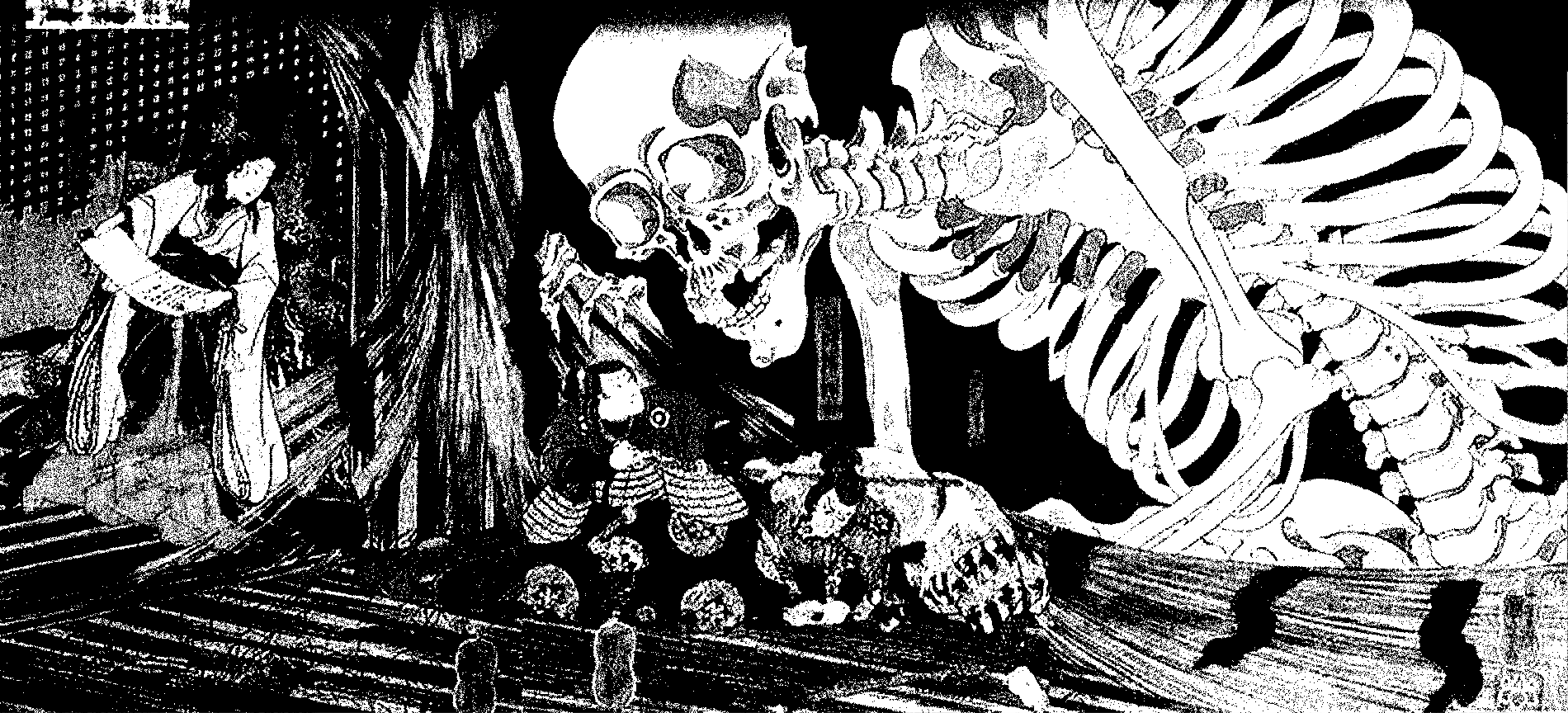
De haber sabido
que muerto estaba ya,
habría llorado inconsolable
mi vida.
– Ōta Dōkan
El harakiri de la modernidad se ejecuta sosteniendo las entrañas del Y2K con una mano y la navaja de Ockham con la otra. Esta arma de parsimonia, atribuida de origen al teólogo inglés W. Ockham en el siglo XIV y retomada por la big tech en forma de motto (Keep It Short and Simple), ha mutado hasta convertir al tropo en la tecnoGUN predilecta de la cultura pop. Territorio donde la evisceración comunitaria pone fin a cualquier potencial político, optando por imponer una sobresimplificación, cómoda e inofensiva, a cuestiones tan complejas como la identidad generacional, la autovigilancia o la hiperstición de la máquina final.
Invocando a Ōta Dōkan –arquitecto del Castillo de Edo, monje budista y samurai– nos arrodillamos apoyando empeines a contra suelo; espalda recta, sake a la garganta y la hermosa poética yuigon (últimas palabras) verdadera sólo en el suicida.
PRIMER MOVIMIENTO: Incisión
Para la mayoría de los samuráis, apuntar el filo del cuchillo tantō hacia el costado izquierdo de su abdomen era suficiente para tildar su muerte de honorable. Llegado este punto, el kaishakunin (asistente) le decapitaba para evitar: la clavada metálica sobre sus entrañas, el recorrido de la hoja hacia el lado contrario y su vuelta al centro para rebanar verticalmente hasta el esternón. Corte a mayor avance ritual, mayor honor post mortem.
El filo del primer impacto lo componen las artistas Sabrina Carpenter y Olivia Rodrigo, quienes establecen no sólo la línea base de feminidad contemporánea, sino también la manera sistémicamente aceptable de “subvertirla”. Carpenter encarna una versión actualizada de la trad-pop-girl: linda, carismática y, sobre todo, alejada de cualquier controversia política. Rodrigo da un paso más allá mostrándose sensual, rebelde y con una sensibilidad proactiva motivada no por la reflexión de sus condiciones, sino por una narrativa de dignificación más bien ególatra.
Hasta hace no mucho, era necesario explorar otras líneas artísticas para encontrar alteridad, lo que terminaba exponiendo al escucha a la raíz de los discursos. Pensemos en la distancia entre Pixies, Kim Deal y The Breeders tirada hacia la volatilidad del núcleo político-feminista del Riot Grrrl. El espectro Rodrigo-Carpenter, por otra parte, comprende un continuo de identidades tan diverso como en línea con lo hegemónico.
Así, el pop ofrece tanto un tropo base como una gama de alternativas deseables hasta el otro “extremo”. Todo en un conveniente abanico soft sound, amigable para el consumidor, seguro para la industria y políticamente inoperante.
SEGUNDO MOVIMIENTO: Tajada
Tras la primera cisura, el acto era frecuentemente delegado del ejecutante debido a la brutalización de sus sentidos. Entre los factores a considerar encontramos: el largo y filo de la hoja, la profundidad y aceleración del corte, la constitución física del samurái, así como el posible rebanamiento de hueso, arterias y órganos internos. Corte a una lenta y dolorosa liberación sobre las alas del espíritu hemorrágico.
Si el primer movimiento alinea, perfila y controla el abanico sensible, el segundo stage metafórico mutila la expresión desde su raíz. Esto mediante el tropo en su forma negativa, ahora como suma de características a suprimir, capturando así uno de los pilares del potencial político: la expresión individual.
Durante los años ochenta, las comedias televisivas se apoyaban fuertemente en los estereotipos consolidados a lo largo del siglo XX, desde el jock hiperatlético y mononeuronal, hasta el intelectualoide infraviril con n o más dioptrías. La dinámica de cada personaje (de repudio o aceptación hacia los demás) se establecía a partir de sus diferencias.
En un territorio con etiquetas virtualmente infinitas –como el de la digitalidad globalizada– recalcar las posibles diferencias se lee profundamente ineficiente. Es ahí donde un tropo tan maleable como lo cringe responde a las nuevas exigencias de la economía interpersonal, convirtiendo cualquier rasgo individuante en motivo de humillación y actualizando las dinámicas de autovigilancia.
Cuando toda identidad es socialmente degradable, la solución parece recaer en la abstinencia personal: minimalismo, neutralidad, apatía performativa y rechazo al tryhard. Pero mutilar todos los puntos frágiles de la personalidad es, también, erradicar cualquier espacio íntimo de reflexión política.
TERCER MOVIMIENTO: Evisceración
A la profundidad correcta, el suicida expulsará sus intestinos, arterias epigástricas, grasa y venas abdominales al compás de la doble presión interna y contracciones musculares. No sin antes atravesar un estado de desvanecimiento –causado por la pérdida sanguínea–, seguido de uno de agitación sensible y prolongada (esto entre taquicardia compensatoria, adrenalina paliativa y una muerte ritual en expiación). Corte a la tortura de saber exactamente cómo serán los últimos segundos y no poder detenerlo.
La potencia aparente de la simplificación se despliega sobre el –una vez vasto– terreno de posibilidades, advirtiendo sobre el peligro de la distopía hollywoodense, pero haciendo espacio para las fauces abiertas de lo ininteligible.
Aquí, el imaginario pop se compone de: apéndices cromados y omnireactivos, autonomía de ataque y reconocimiento, faros LED rojo-cyberpunk, fascismo flagrante y un killswitch al alcance de nuestros protagonistas. En este escenario, apelar a la parsimonia de la katana es enfocarse en el centro iluminado de la habitación, pasando por alto las esquinas, lo poco obvio, la sutileza del Tíndalos y sus perros caza.
El asesinato de la cultura contemporánea (y quien la ostenta) se propulsa desde el futuro-no-capturable, accionado vía el gregarismo de vigilancia ultrafina, la autoexplotación del individuo en función de su mejor-yo, la normalización de drones de grado militar con reconocimiento facial, la extracción irregulable de biométricos en países colonizados, el monopolio de las big tech y su hipertrofia tecnocrática: la lenta evisceración del tejido social.
La mirada debe fijarse en aquello que busca precisamente evitarla.
— Nujabes Got My Back
If I had known
I was already dead,
I would have cried inconsolably
my life.
– Ōta Dōkan
The harakiri of modernity is carried out holding the entrails of Y2K in one hand and Occam’s razor in the other. This parsimonious weapon—originally attributed to the 14th-century English theologian William of Ockham and later embraced by Big Tech as the motto “Keep It Short and Simple”—has mutated into the pop‑culture’s favored tecnoGUN. A territory where communal evisceration puts an end to any political potential, opting instead to impose a comfortable, harmless oversimplification on issues as complex as generational identity, self‑surveillance, or the hyperstition of the final machine.
By invoking Ōta Dōkan—the architect of Edo Castle, Buddhist monk, and samurai—we kneel with our insteps against the ground; spine straight, sake at our throat, and the beautiful poetic yuigon (final words), true only true for the suicidal.
FIRST MOVEMENT: Incision
For most samurai, pointing the tantō blade toward the left side of the abdomen sufficed to make their death honorable. At that point, the kaishakunin (assistant) would behead them to prevent the blade from penetrating their entrails, slicing through and returning to the center to vertically cleave up to the sternum. Further the ritual, greater the posthumous honor.
The edge of the first strike is composed by artists Sabrina Carpenter and Olivia Rodrigo, who set not only the baseline of contemporary femininity but also the systemically acceptable way to “subvert” it. Carpenter embodies an updated version of the trad-pop-girl; cute, charismatic, and most importantly, devoid of political controversy. Rodrigo goes one step further, presenting herself as sensual, rebellious, with a proactive sensitivity driven less by reflection on her conditions than by a rather egocentric dignification narrative.
Until recently, one had to explore other artistic lines to find alterity, exposing the listener to the roots of discourse. Consider the distance between the Pixies, Kim Deal, and The Breeders leaning toward the political‑feminist core of Riot Grrrl. The Rodrigo‑Carpenter spectrum, on the other hand, spans a continuum of identities as varied as they are aligned with the hegemonic center.
Thus, pop offers both a base trope and a range of desirable alternatives up to the other “extreme.” All within a convenient soft‑sound, fanfriendly for the consumer, safe for the industry, and politically impotent.
SECOND MOVEMENT: Slice
After the first fissure, the act was often delegated by the executor due to sensory brutalization. Factors to consider included the length and sharpness of the blade, the depth and speed of the cut, the samurai’s physical constitution, and the potential slicing of bone, arteries, and internal organs. A slow and painful release on the wings of the hemorrhaging spirit.
If the first movement aligns, profiles, and controls the sensitive spectrum, the second stage metaphorically mutilates expression at its root. It does so through the trope in its negative form, adding up features to suppress—thereby capturing one of the pillars of political potential: individual expression.
In the 1980s, TV sitcoms relied heavily on stereotypes consolidated during the 20th century, from the hyperathletic, mononeuronal jock, to the intellectualloid with n or more diopters. Each character’s dynamic (whether repudiated or accepted by others) was established through their differences.
In a territory with virtually infinite labels—such as global digitality—highlighting possible differences seems deeply inefficient. This is where a trope as malleable as “cringe” responds to the new demands of interpersonal economy, turning any individuating trait into a source of humiliation and updating dynamics of self-surveillance.
When every identity is socially degradable, the solution appears to lie in personal abstinence: minimalism, neutrality, performative apathy, and rejection of “try‑hard.” But to mutilate all the fragile points of personality is also to eradicate any intimate space for political reflection.
THIRD MOVEMENT: Evisceration
At the proper depth, the suicidal will expel intestines, epigastric arteries, fat, and abdominal veins in rhythm with internal pressure and muscular contractions. Not without first passing through a state of fainting—brought on by blood loss—followed by a prolonged sensitive agitation (compensatory tachycardia, palliative adrenaline, and ritual expiatory death). The torture of knowing exactly what the final seconds will be like and being unable to stop it.
The apparent power of simplification deploys over what was once a vast terrain of possibilities, warning us against Hollywood dystopia while leaving room for the open maws of the unintelligible.
Here, the pop imaginary consists of: chrome omni‑reactive appendages, autonomous attack and recognition, red‑cyberpunk LED beacons, blatant fascism, and a killswitch at our protagonists’ fingertips. In this scenario, invoking the parsimonious katana means focusing on the illuminated center of the room—overlooking the corners, the obscure, the subtlety of the Tindalos and its hounds.
The murder of contemporary culture (and those who display it) is propelled from the non‑capturable future, driven by ultrafine surveillance gregariousness, self‑exploitation toward the “better self,” normalization of military‑grade facial‑recognition drones, biometric extraction in colonized nations, Big Tech’s monopoly hypertrophied by technocracy: the slow evisceration of the social fabric.
Our gaze must fix on that which seeks precisely to avoid it.
— Nujabes Got My Back

Leave a Reply